
CURRENT APPEAL · RENATE HOLZEISEN · NOVEMBER 22, 2026
VOTE POSTPONED.
ENFORCE PROTECTION RULES.
Renate Holzeisen calls for the vote to be postponed and for MPs to be informed about the disputed regulations before a final decision is made. Your new contribution combines the criticism of approval and safety assessments with the already advanced parliamentary procedure.
What has already been decided in the committee.
The official recommendations explain that the Council position reflects the agreement previously negotiated between Parliament and the Council. The Committee on Public Health (SANT) recommends that the plenary approve both Council positions. Its final votes took place on November 10, 2026.
| Template | Yes | No | Abstentions |
|---|---|---|---|
| Guideline/Medicines Code | 31 | 1 | 6 |
| Regulation / EMA and central approvals | 31 | 2 | 5 |
Christine Anderson voted against the directive; Gerald Hauser abstained. Both voted against the ordinance. Marie-Sophie Christ, Peter Liese, Andrea Wechsler, Günther Sidl and Martin Häusling are among the yes votes on both proposals.
Official recommendation on the directive: A10-0297/2026 · Official recommendation for the regulation: A10-0296/2026
The four document extracts provided.
The illustrations show the original German extracts. To read, open the graphic at full size; the official source is below.
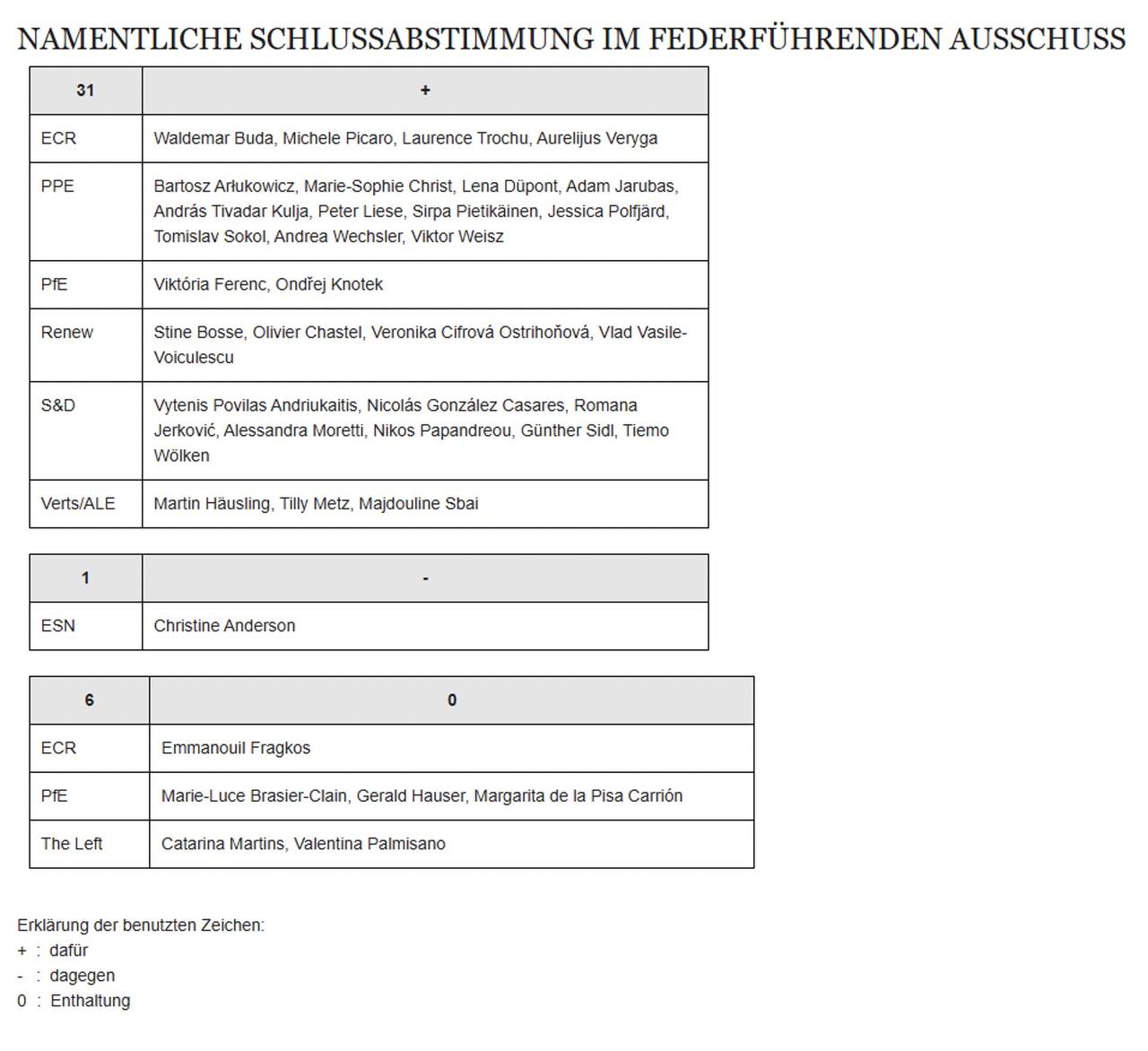
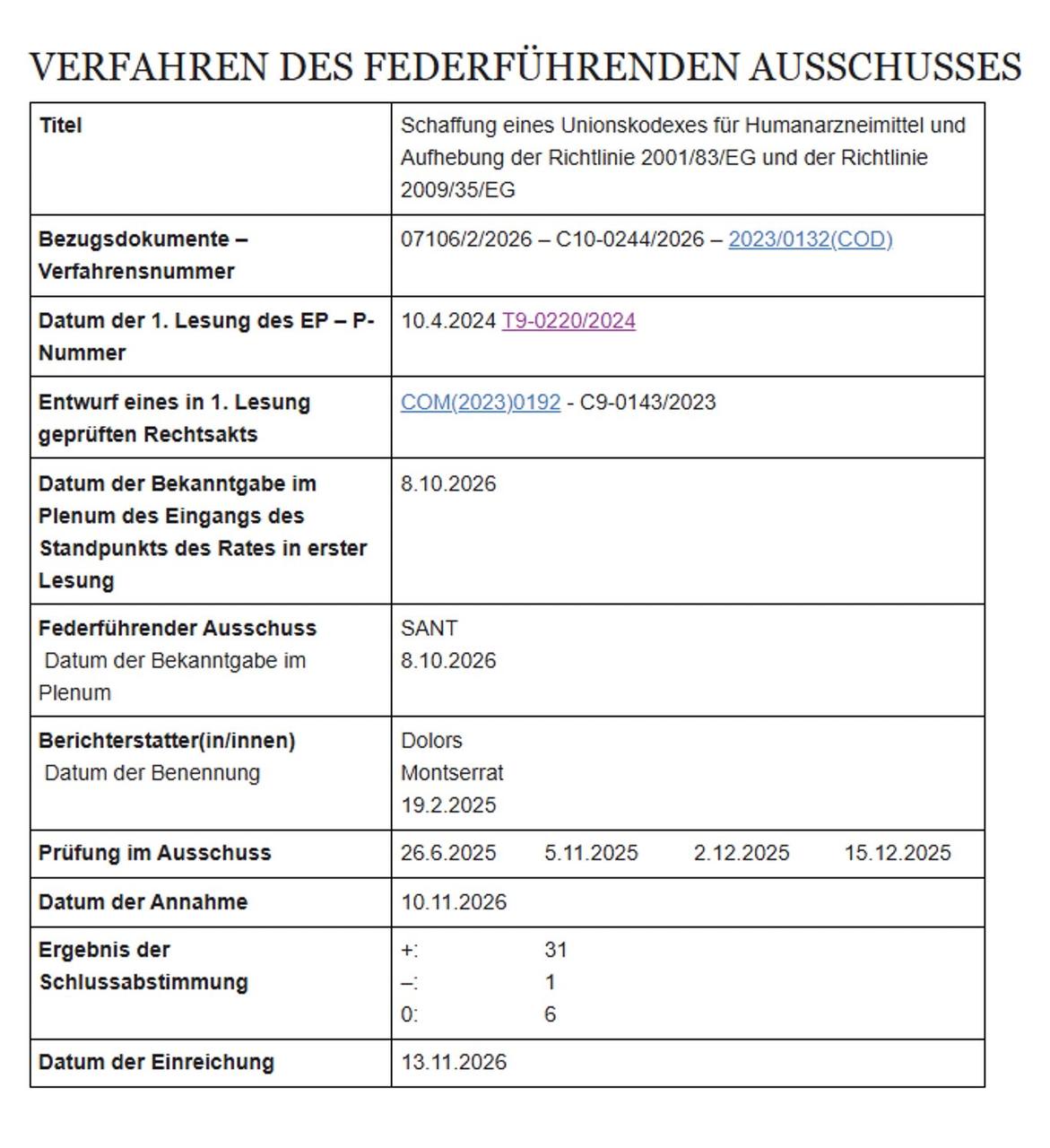
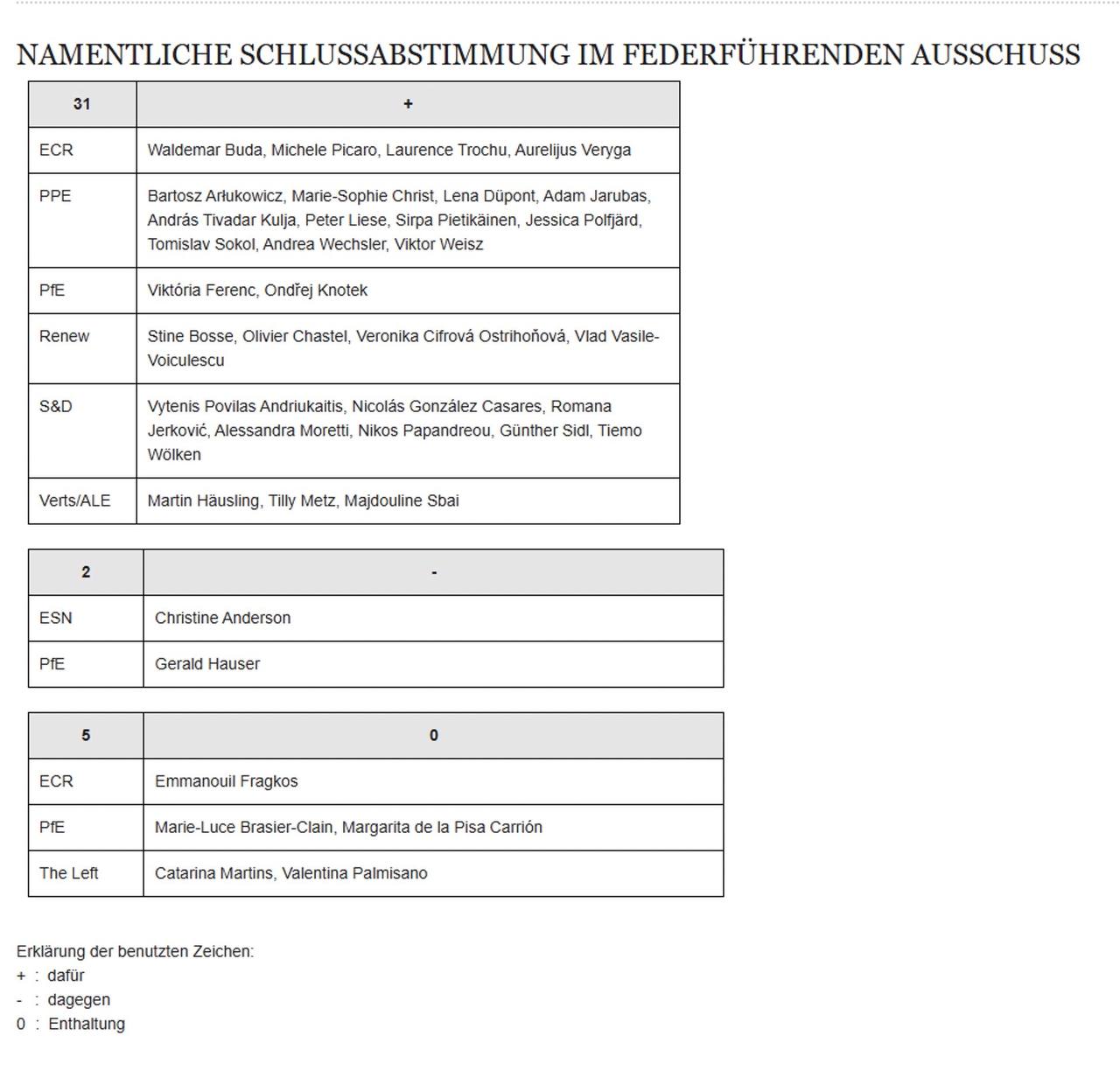
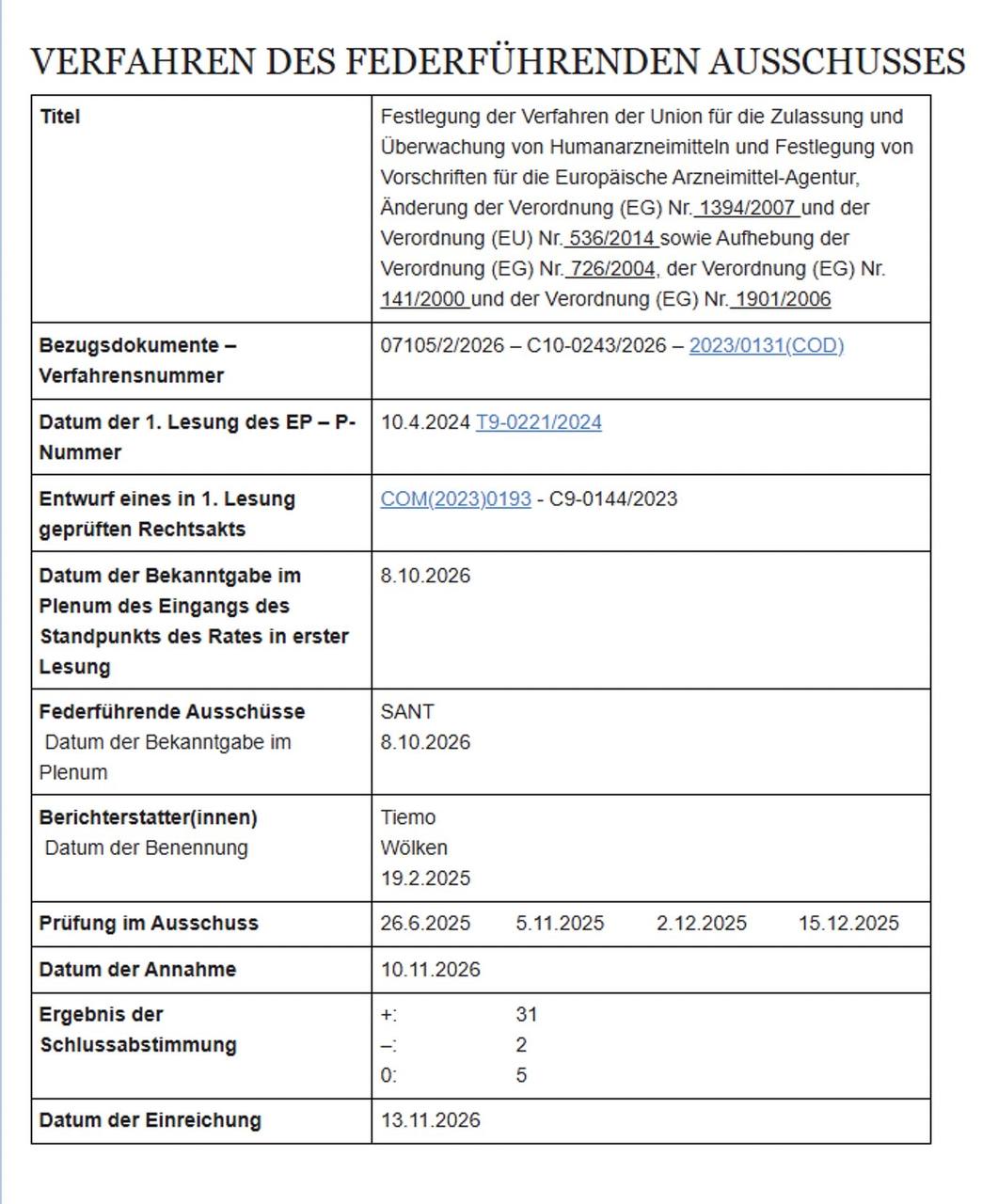
Original contributions and original documents also remain accessible in the original language. Read German original
PREVENT OBLIGATION AND ESCAPE OF LIABILITY.
Anyone who requests treatment
must bear responsibility.
“Recommended or required” also includes applications required by authorities. The danger of mandatory application must therefore be explicitly addressed. Our political standard is clear: no treatment against the will of those affected. No exception to liability at the expense of injured parties.
The directive position provides for an exemption from civil and administrative liability for certain officially recommended or required applications. It covers unapproved medicines and medicines outside their therapeutic indications. He cites the trigger as a suspected or confirmed spread of pathogens, toxins, chemicals or nuclear radiation that could cause harm.

Corona: Those affected are already fighting for access to justice.
The linked documentation on COVID liability shows dismissed lawsuits, information decisions and referrals back. The problem is concrete: Without information from the manufacturer, it can be difficult for those affected to even prepare a claim for damages. We therefore demand open documents and enforceable responsibility.
In the case VI ZR 335/24, the Federal Court of Justice overturned the judgment of the Koblenz Higher Regional Court on March 9, 2026 and remanded the matter. He complained that the requirements for the right to information were too high. This does not yet result in a final award of compensation. The statement that all liability claims have finally failed would not be proven in view of such ongoing proceedings.
COVID liability: procedures and linked originals ↗
Federal Court of Justice · VI ZR 335/24 · Judgment of March 9, 2026 ↗
Article 4(6) expressly does not affect liability for defective products under Directive (EU) 2024/2853. Article 4 paragraph 5 alone does not create a general obligation to treat or vaccinate. A specific mandatory application requires an independent legal basis. Especially for such constellations, the connection with the liability exception is politically explosive.
The basic structure of the exception has been in Article 5 of the previous Directive 2001/83/EC since 2004. Our demand is directed against their inclusion in the new code. It's about human medicines as a whole; An initial expansion of only corona vaccines to other medications cannot be derived from this.
Official directive position · Article 4 in full ↗Previous Medicines Code · Article 5 ↗
What we ask for: Delete Article 4(5). Protect free consent. Make manufacturer information accessible. Secure independent safety audits and effective compensation. Government regulations must not leave people helpless and damaged.
Five years after the start of the corona vaccination campaign, those affected are still fighting for information, evidence and compensation. Dismissed lawsuits, appeals and remands mean an agonizingly long journey. Initial improvements in access to information are not yet compensation. This struggle can become existential for those affected. Our warning: This drama must not be repeated with other medicines. Citizens must not be left defenseless against government regulations and the consequences of damage.
View Corona liability proceedings and original decisions ↗“RECOMMENDED OR REQUIRED”: EVEN A MANDATORY USE IS A RISK HERE.
The liability exception expressly also applies to authorities demanded Applications – for unapproved medicines or use outside the approved indication. Anyone who is supposed to follow government guidelines needs protection and enforceable claims. Obligation and escape from liability must not come together.
The reform affects pharmaceutical law as a whole, far beyond corona vaccines. This liability model must have no future in the new pharmaceutical law. We demand: delete Article 4 paragraph 5. No treatment against the will of those affected. No exceptions to the detriment of injured parties.
Article 4 paragraph 6 expressly preserves product liability. What is crucial is whether those affected can actually enforce their claims. We demand free consent, open security data and effective compensation.
Read the wording, legal basis and Corona rulings in fullCheck security.
Limit exceptions.
Safety assessments that reflect the actual composition and mode of action of a drug product. The actual composition and mode of action must also be decisive when defining and legally classifying gene therapeutics. A designation as a vaccine must not replace the necessary safety assessments.
Lawyer Renate Holzeisen's criticism is directed, among other things, at the distinction between vaccines and gene therapeutics, against the use of platform data, against real-world laboratories and against the Commission's delegated powers. Their full argument, proposed deletions and extensive appendices are available below.
Definitions and RNA-based products
Article 5 of the Directive Position contains the definitions. The vaccine definition includes prevention and treatment of an infectious disease. The definition of gene therapeutics excludes vaccines against infectious diseases. Neither the specific effect on the human genome nor the danger of an individual product can be derived from this regulatory classification alone.
Our demand is specific: the required scope of investigations must be scientifically justified based on the risk profile of the respective product. It must be clear which tests are required and why individual evidence is omitted. Classification as a vaccine must not be an excuse for unfounded security gaps.
Platform technologies
Platform technologies should make it possible to reuse suitable existing data. Recital 110 and Article 23 require scientific justification of applicability and adaptation to the specific product. This does not result in a blanket abolition of clinical and preclinical examinations. What remains to be clarified politically is how transferability will be independently examined and disclosed.
Real-world laboratories
The regulation regulates real-world laboratories in Articles 116 to 118. It provides for controlled regulatory adjustments and official monitoring. Safety, effectiveness and quality requirements remain relevant. Article 117 requires authorization and a positive benefit-risk ratio before marketing; Article 118(2) maintains liability under Union and national law.
We demand binding limits: transparent adjustments, independent control, safety assessments that do justice to the actual composition and mode of action of a drug product and enforceable responsibility. Patient rights must not depend on political enthusiasm for a technology.
Official regulatory position · Articles 116 to 118 ↗Who takes the risk?
The advance purchase agreement.
The Pfizer/BioNTech advance purchase agreement provided addresses exemption by participating Member States in Section I.12. The attached German translation and the English document are available in full.
The order form contains references to the rapid development, continued investigations and uncertainties at the time regarding long-term effects, effectiveness and still unknown side effects. These formulations refer to the level of knowledge when the contract was concluded. They do not replace a later product-related review.
A contractual exemption regulates who bears certain costs between the contracting parties. It is not the same as extinguishing every claim of an injured person. In addition to intentional misconduct, Section I.12 also contains a more specific exception for significant violations of good manufacturing practice that lead to the quality defects and official measures described there.
Our demand: Disclose procurement conditions and government risk assumptions. Ensuring that injured parties have practical access to legal protection and compensation. Accountability must remain transparent.
Full English Advance Purchase Agreement ↗Link provided at RAI · full English versionGerman translation provided ↗Full document on Google DriveNovember 25th.
The MPs are acting now.
The published final draft agenda lists both projects for Wednesday, November 25, 2026, in the voting block from 12 p.m. to 1 p.m.
The countdown ends at the start of this block at 12 p.m. CET, i.e. German and Strasbourg local time. A minute-by-minute individual vote is not specified. Changes to the agenda remain possible. Status of the exam: November 22, 2026.
This is about the second reading of the Directive on the Union Code of Medicinal Products for Human Use, procedure 2023/0132(COD), and the regulation on authorization, supervision and the European Medicines Agency, procedure 2023/0131(COD). The Council adopted its position on September 28, 2026.
Our demand to EU representatives: No approval of this version without binding protection rules. Check the parliamentary options that are still permissible and make your own position public before the vote. To the federal and state governments: monitor the responsible governments in parliament and take a public position.
The published draft agenda already states November 18th at 1 p.m. as the submission deadline for motions for amendments and rejections to these two reports. The author's updated guide remains accessible as a full, original post. Which applications are still admissible must be checked based on the current rules of procedure and procedural situation. Rule 67 of the Rules of Procedure does not impose a general prohibition on a second reading earlier than the last sitting before the deadline.
Official agenda for November 25th ↗Voting block 12 p.m. - 1 p.m. · Procedure and deadlinesUpdated action plan by RA Renate Holzeisen ↗Complete Guide · 12 pagesUpdated amendments and explanations ↗Complete appendix · 54 pagesADDITIONAL PRESS RELEASES
Medical freedom.
Enlightenment. Responsibility.
In the two press releases provided, the Doctors' Association for the Hippocratic Oath (ÄBVHE) criticizes financial vaccination incentives and vaccination offers in the event environment. It warns of health risks and calls for responsible, individual medical decisions and information.
The complete documents contain the association's arguments, sources, assessments and medical and legal conclusions. They are documented here as its position. The reports and statistical connections mentioned do not in themselves prove causal damage caused by vaccination. This cannot replace an individual medical assessment.
Disincentives in EBM · Press release from November 11, 2026Unedited PDF provided · 3 pages · read in fullMedical association warns against Oktoberfest vaccinations: life and liability risksUnedited PDF provided · 6 pages · read in fullWhat the remuneration rule specifically provides
The KBV explains the maintenance fee for general practitioners' practices: If fewer than ten vaccinations are billed per quarter, this flat rate is generally reduced by 40 percent. Specific practices mentioned are excluded. This is a discount on the maintenance fee and not on the entire practice fee.
A vaccination performance criterion for surcharges is based on the number of vaccination services billed: seven percent of treatment cases in the first three quarters, 25 percent in the fourth quarter. The surcharges also depend on several of the ten criteria. The number of vaccination services does not equate to a quota of unique vaccinated people.
The campaign calls for these incentives to be examined for their impact on advice, freedom of treatment and decisions in individual cases. The current STIKO recommendations are to be differentiated according to standard and indication vaccinations as well as risk groups; The general statement “only for people over 75” does not cover every indication.
KBV: applicable retention fee ↗ · RKI: current COVID-19 vaccination recommendations ↗
The complete ones
contributions provided.
The following texts are reproduced as original contributions by their respective authors. The political evaluations, comparisons and accusations contained therein come from the contributions provided.
All documents.
Openly accessible.
- Original analysis of the directive and regulation · Renate Holzeisen
- Original action plan · Renate Holzeisen
- Updated action plan · full version
- Updated annex: recommended amendments · full version
- German translation of the advance purchase agreement · complete version
- Pfizer/BioNTech advance purchase agreement · original English file
- ÄBVHE: Disincentives in EBM · complete original file
- ÄBVHE: Oktoberfest vaccinations · complete original file
The original appeal uses the same link for “Action Plan” and “Attachment”. Both references remain in the original post; the separate updated documents are also linked.
Official sources.
- Directive: Council position on the Union Code relating to medicinal products for human use · Article 4, Article 5 and Article 23; Recital 110.
- Regulation: Council position on authorization and the European Medicines Agency · Articles 116 to 118.
- Council of the EU: Decision of September 28, 2026
- European Parliament: published voting schedule
- Final draft agenda: Wednesday, November 25, 2026
- Rules of Procedure of the European Parliament: Article 67
- KBV: retention fee
- Robert Koch Institute: COVID-19 vaccination recommendations
The campaign's political demands are its own position. The fully provided statements are also available as contributions from their authors. The complete official texts are decisive for the specific legal consequences.
Contacts from all 27 EU countries.
The campaign contains 10,055 contacts: 8,157 people from research on the EU parliaments and 1,898 existing contacts from all 16 German state parliaments. The research includes 720 MEPs and 39 national parliamentary chambers. Duplicate EU and Bundestag entries were merged.
There are 9274 published email addresses stored in the total inventory. 781 people do not have a published email address. They remain visible; Email addresses are not guessed. 1143 email contacts in the research inventory have older or secondary documents. Identifying a contact is not proof of technical deliverability. Research status: November 22, 2026.
Common faction, ministry and office mailboxes are marked. Deputy members, people on leave, religious representatives and open mandate examinations remain identifiable. The number of contacts is therefore not an indication of the number of active seats. The Spanish inventory includes the recorded standing committees of the dissolved chambers. Personal email addresses are missing for Portugal and the Slovenian National Assembly; Contact forms stored remain linked.
The country view only shows contacts from the selected country. Multiple chambers can be selected at the same time. Constituency filters use published information. Without a proven location, no regional reference will be invented. For Germany, the separate selection according to federal state, location and constituency remains. A newly recorded Bundestag contact does not yet have a proven regional assignment and can be reached in the nationwide directory.
The assignment of German municipalities to federal constituencies uses the official table of the Federal Returning Officer for the 2025 federal election. In the case of divided municipalities, no exact constituency is derived from the place name or a postal code. State parliament assignments are only partially available and are confirmed by the user. The older state parliament portfolio was not completely re-examined for mandates.
The regional EU references in Germany come from the federal state pages “Europe on Site” published by the European Commission Representation. They are published regional references, not local EU constituencies. Names that cannot be clearly assigned will not be automatically replaced.
Language information is generally correspondence suggestions by country, unless an individual source is available. Multilingual countries retain their language options. Personal knowledge of the language is not derived from name, place of residence or country.
Imprint.
Friends of Democracy e.V.Main Street 41
21266 Jesteburg
Germany
Representation: Markus Bönig, 1st chairman, authorized to represent together with another board member.
Telephone: 040-537981525
Email: support@fdd.team
Association register: AG Tostedt, register number 201664.
We are not willing or obliged to take part in dispute resolution proceedings before a consumer arbitration board.
Data protection.
The email campaign works without a backend and without a database. Sender data, selection and processing status are stored in the RAM of the open browser tab. There is no automatic storage of this information on the server and no analysis or tracking services. Font files, images and contact details are located locally in the page package.
When you open an email, the page transfers the recipient address, subject and message to the email program assigned by the device. The message text contains the sender details entered and the place of residence. Only the user sends the message there. A webmail provider can process the data as part of the account used there.
External documents are only loaded when the respective links are accessed. The terms and conditions of the respective provider apply, such as Google Drive, RAI, EUR-Lex or the European Parliament. This website is hosted on webspace provided by united-domains. Access may generate technical server logs. The association identified in the legal notice is responsible for this website.
The extension holds drafts temporarily in local session storage only. Deleting them or closing its tab removes them. No transfer to a server.
The demand stands.
Now select the regional contact person and send the prepared campaign text personally.
Select representatives & prepare emails